 GameWiki

GET YOUR BEARINGS
About Dupery: A Game of Solo Deduction
Dupery: A Game of Solo Deduction drops you into a noir‑styled city ruled by a criminal syndicate. As a lone detective you investigate procedurally generated cases on a grid of characters, each belonging to one of four role categories – Innocent, Meddler, Underling or Traitor – and use clues to pinpoint the evil.
Your reputation acts as a safety net: arresting good‑aligned roles drops it, while catching every evil role raises it and unlocks the next case. Three distinct regions provide unique mechanics, and completing all nine role tiers across them leads to a final showdown with the syndicate’s mastermind.
01 / THE GUIDE
Role Categories
Every character you meet fits into one of four categories. Innocents are generally trustworthy, Meddlers may have hidden motives, Underlings are known liars, and Traitors lie the most and actively sabotage you. The game features over 175 handcrafted roles spread across these groups.
Understanding each category’s typical behavior helps you cross‑reference statements and spot contradictions. The Mathematician, for example, reveals the sum of all evil role addresses, while the Critic doubles reputation loss, illustrating how role abilities can affect deductions.
- Note the category label when first encountering a character; it frames how much you should trust their testimony.
- Compare numerical clues from roles like the Mathematician with location data to narrow down evil positions.
02 / THE GUIDE
Reputation System
Your reputation meter tracks how well you perform as a detective. Arresting good-aligned roles reduces reputation, and letting it fall too low results in being fired. Conversely, arresting all evil roles in a case raises reputation and lets you choose the next investigation.
Reputation also interacts with specific roles; the Critic can double the loss you suffer from a wrongful arrest. Maintaining a high reputation is essential for progressing to later regions and the final boss encounter.
- Prioritize confirming a suspect’s alignment before arrest to avoid unnecessary reputation loss.
- Watch for roles that modify reputation effects, such as the Critic, and adjust your strategy accordingly.
03 / THE GUIDE
Procedurally Generated Cases
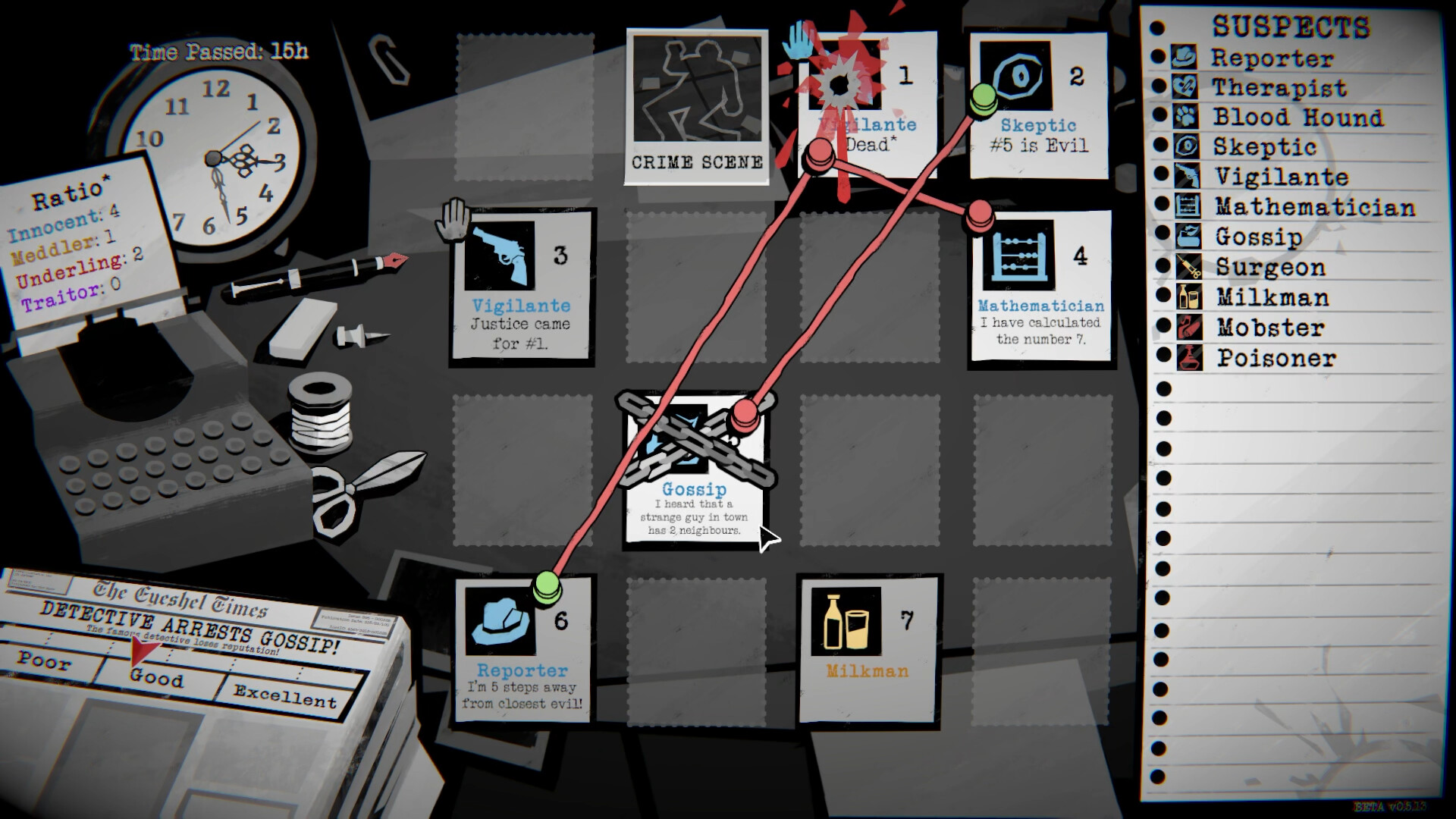
Each case is built on a grid that mixes good and evil roles, and the layout changes every run. Clues are provided by characters, and you must piece together imperfect information using strings, pins, and pen on your detective board. No two runs play the same, ensuring fresh deduction challenges each time.
The procedural nature also means the number of roles, their positions, and the specific clues vary, so you cannot rely on memorization. Instead, focus on logical deduction and pattern recognition across each unique setup.
- Treat each new grid as a fresh puzzle; avoid assuming previous case layouts will repeat.
- Use the notation toolkit to keep track of statements and contradictions as they appear.
04 / THE GUIDE
Campaign Regions
The game offers three campaigns set in distinct regions, each introducing its own mechanics and role types. Completing a region’s cases advances you toward a final confrontation with that region’s syndicate general, granting clues for the next area. Unlocking all nine tiers of roles across the three regions opens the Syndicate’s region for the ultimate boss run.
Each region’s unique mechanics alter how you approach deduction, encouraging adaptation. For example, one region may emphasize numerical clues while another focuses on reputation modifiers, requiring you to adjust your investigative style.
- Experiment with different role selections between missions to discover which mechanics suit your playstyle best.
- Take note of region‑specific quirks; they often hint at the most effective deduction strategies for that area.
05 / THE GUIDE
Customization Tools
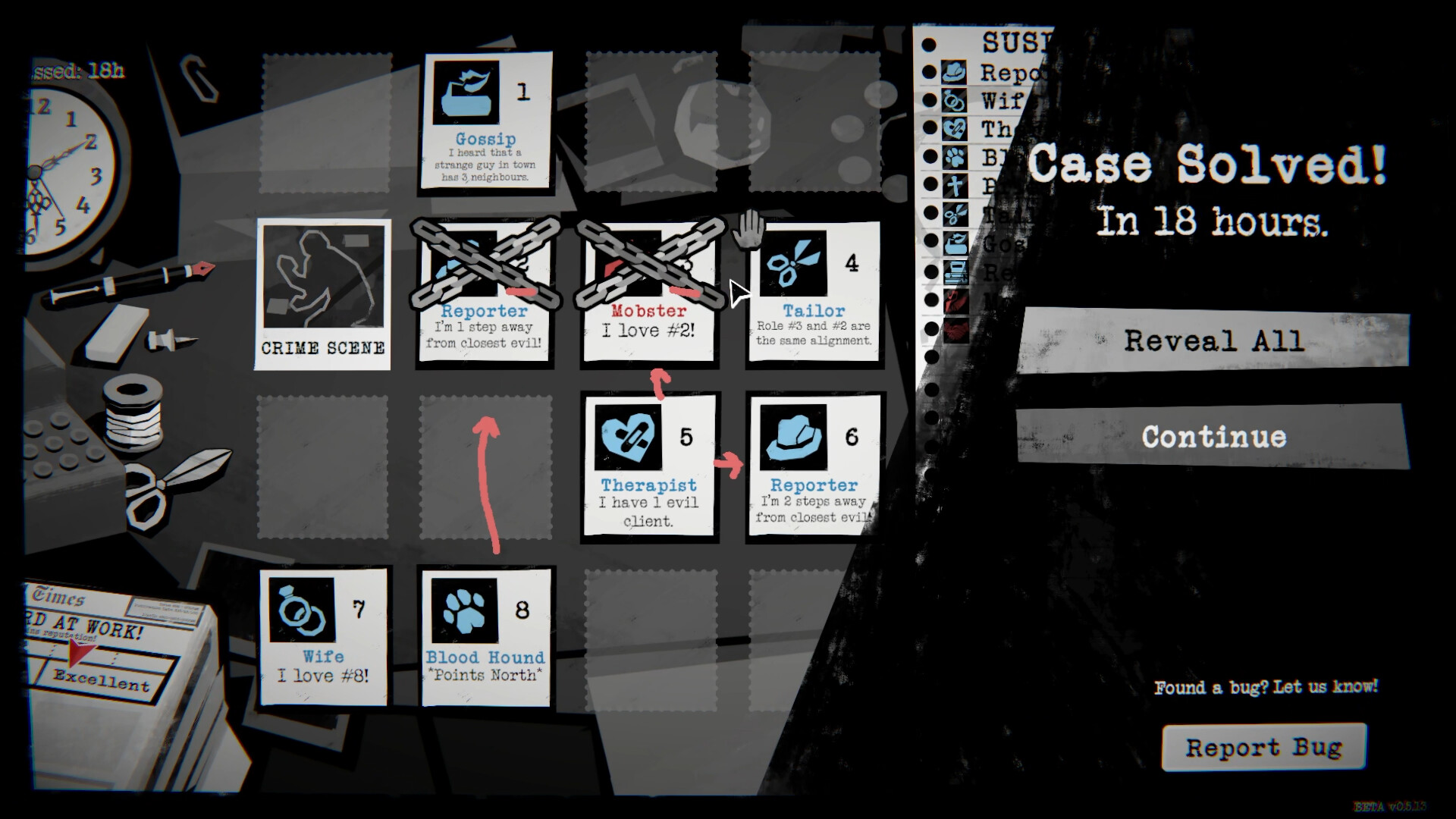
Between missions you can choose which roles to add to upcoming cases, as well as acquire quirks and modifiers that shape each run. The game provides a notation toolkit for building an in‑game crime board, allowing you to record strings, pins, and other clues on a virtual surface.
These tools let you tailor the difficulty and complexity of each case, offering a personalized deduction experience. Selecting specific quirks can introduce new challenges or aid your investigations, while the crime board helps visualize relationships among characters.
- Use the notation toolkit to map out suspect connections; visual aids often reveal hidden patterns.
- Try different quirks and modifiers to find a balance between challenge and enjoyment.



COMMUNITY
Player discussion